How it works
The perceive, reason, act loop — request flow, what gets traced, and how drift detection and autopilot fit together.
DriftWatch has one idea: instrument an agent's decisions as telemetry, then run a model over that telemetry to notice and act on any behavioral change.
Three stages: perceive (observe every decision), reason (detect drift), act (remediate, with a human in the loop).
Request flow
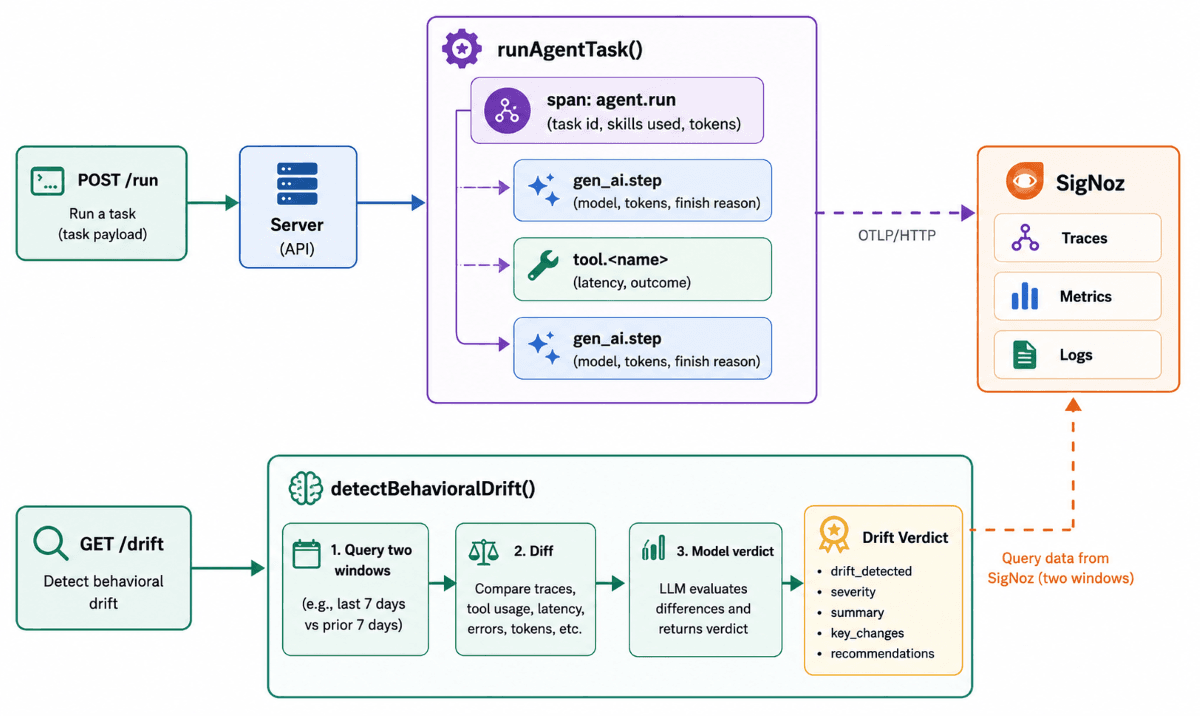
Each /run executes a tool-use loop and, in the same pass, emits the telemetry
that later feeds drift detection. Nothing is bolted on after the fact — the
observability is the execution path.
Perceive — what gets traced
One root span per task, agent.run, carries the task id, the tools used, the
token spend, and the provider/model. Inside it, each model step is a
gen_ai.step span and each tool call is a tool.<name> span. Three
low-cardinality metrics (agent.tool.calls, agent.tool.duration,
agent.tokens) aggregate the same activity for charting and drift.
Details and dashboard queries: prometheus.md.
Reason — detecting drift
detectBehavioralDrift compares two time windows (baseline vs. current),
diffs the agent's behavior including tool-call mix, error rate, p95 latency, and token spend,
then asks the model to classify whether it drifted enough to warrant a human
alert. The verdict is schema-typed (drift, severity, reasons,
recommended_action). A dry-run mode uses fixtures so you can
see the whole path before any real traffic exists.
Details: sdk.md.
Act — two control loops
Loop 1 — inline guardrails (synchronous, per request). A hard token/cost cap enforced inside the agent loop, aborting a single runaway call mid-flight before it can even pollute the drift windows.
Loop 2 — autopilot (asynchronous, aggregate). A scheduler detects drift each cycle, evaluates your policy, then dispatches actions: notifications fire immediately; control actions (pause, rollback, throttle, switch model) create an approval a human resolves from Slack, Telegram, or the console. Approvals are atomic and channel-agnostic, so the first response anywhere wins, and multiple server processes coordinate through Redis with a leader lock so exactly one runs each cycle. It runs a safe shadow mode that logs intended actions without taking them.
Details: alerts-and-actions.md.
What you bring
DriftWatch owns the observability and control machinery; you bring the parts that are specific to your agent:
- A model client — any AI SDK provider. No provider is bundled or chosen for you. (server.md)
- Tools — your own tools/skills, wrapped so each call is traced and counted. (server.md)
- Config — typed and validated; from env, or built however your app manages config. (configuration.md)